
To improve punching power, you must focus on the kinetic chain—the efficient transfer of force from the ground, through your legs and core, and into your fist. Power is the product of strength (force) and velocity (speed).
The following three exercises target these specific power-building components:
1. Landmine Punches (or Medicine Ball Punch Throws)
This is considered one of the most specific exercises for developing a “harder” rear-hand punch.
Boxing Science
+1
- How to do it: Place one end of a barbell in a landmine attachment (or corner). In a boxing stance, hold the other end at shoulder height. Explosively drive the bar forward, pivoting your rear foot and rotating your hips as if throwing a cross.
- Why it works:
- Kinetic Chain Sequencing: It teaches you to generate force from the rear foot and transfer it through the core to the hand.
- Maximum Intent: Unlike a standard bench press, a landmine punch (or a medicine ball throw) allows you to accelerate through the entire movement without decelerating at the end, which is crucial for hand speed.
2. Trap Bar Deadlifts (or Heavy Squats)
Punching power starts in the lower body; boxers who can produce higher ground reaction forces generally punch harder.
- How to do it: Use a trap (hex) bar for a more shoulder-friendly neutral grip. Focus on driving through your midfoot to stand up explosively.
- Why it works:
- Rate of Force Development (RFD): Heavy compound lifts improve how quickly your muscles can generate maximum force.
- Effective Mass: Strengthening the legs and core contributes to “effective mass”—the body’s ability to “stiffen” upon impact, creating a sharper snap and more devastating force.
3. Plyometric (Clap) Push-Ups
Explosive upper body movements train the fast-twitch muscle fibers required for a “whipping” punch.
- How to do it: From a standard push-up position, lower yourself and then push off the ground with enough force that your hands leave the floor (add a clap if possible). Land softly and immediately repeat.
- Why it works:
- Upper Body Explosiveness: It specifically targets the pectorals, deltoids, and triceps to improve the speed of arm extension.
- Stretch-Shortening Cycle: This exercise trains your tendons and muscles to store and release energy rapidly, which directly translates to faster, more responsive strikes.
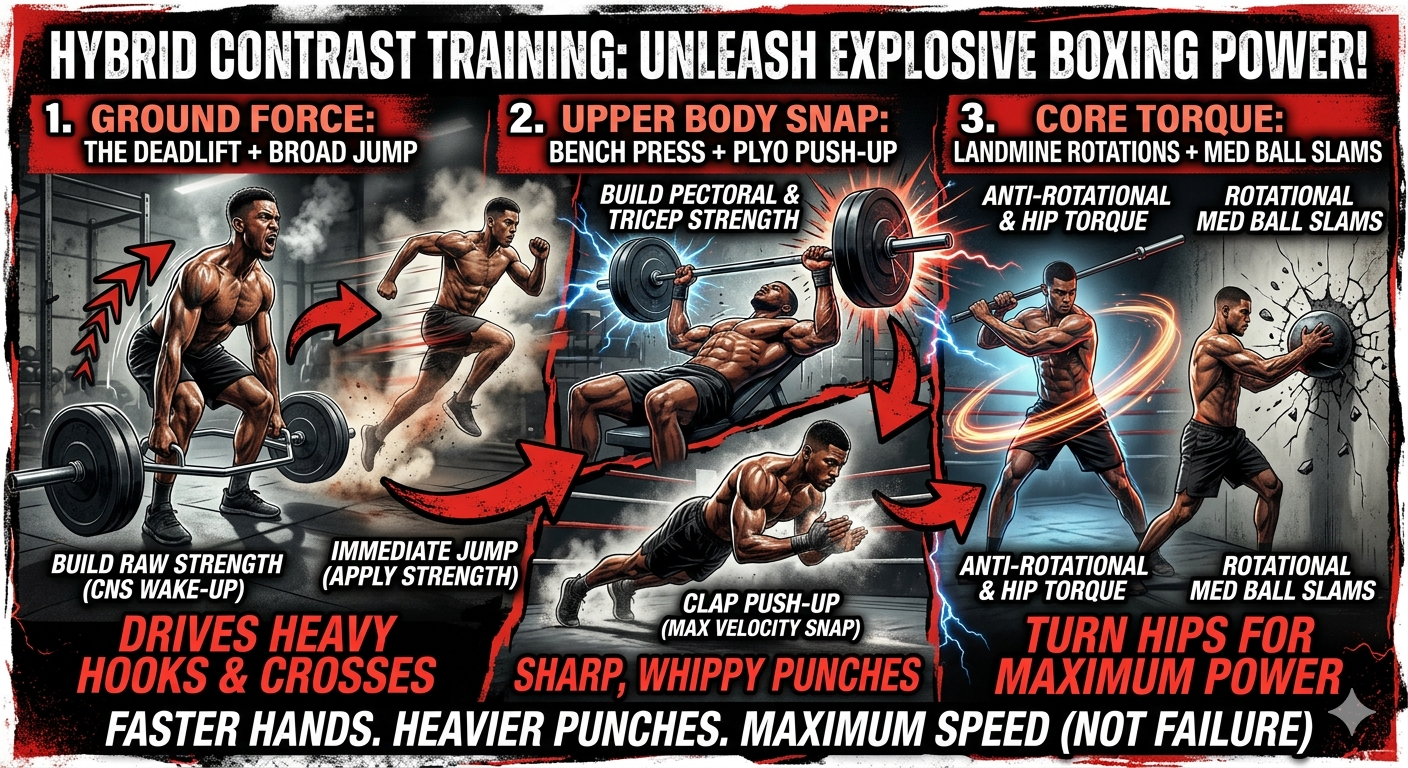
Since you have access to both a gym and can do bodyweight work, you can create a high-performance routine by pairing heavy “force production” lifts with “explosive” bodyweight movements. This is often called contrast training.
Here is a 3-exercise hybrid plan to maximize your power:
1. The Heavy Deadlift + Broad Jump (Ground Force)
- The Exercise: Perform a heavy set (3–5 reps) of Trap Bar Deadlifts, then immediately perform 3 explosive Broad Jumps (jumping for distance).
- Why it works: The heavy deadlift “wakes up” your central nervous system (a process called Post-Activation Potentiation). Following it immediately with a jump teaches your body to use that newly recruited strength for explosive movement. For a boxer, this translates to the “spring” in your legs that drives a heavy hook or cross.
2. The Bench Press + Plyometric Push-Up (Upper Body Snap)
- The Exercise: Perform a set of Barbell Bench Presses at a moderate-to-heavy weight (focusing on a fast upward phase), followed by Clap Push-Ups.
- Why it works: The bench press builds the raw pectoral and tricep strength needed to shove through a guard. The plyometric push-up converts that raw strength into “snap.” This combo ensures your punches aren’t just heavy and slow, but sharp and “whippy,” making them harder for opponents to see coming.
3. Landmine Rotations + Rotational Med Ball Slams (Core Torque)
- The Exercise: Use the Landmineto perform “rainbows” (moving the bar in an arc while keeping your arms straight and core tight), then transition to Rotational Medicine Ball Slamsagainst a wall.
- Why it works: Punching power is largely rotational. Landmine rotations build the “anti-rotational” strength needed to stay balanced, while the med ball slams train your obliques to fire with maximum velocity. This develops the “torque” required to turn your hips into your shots without losing your footing.
Pro Tip: To keep your hands fast, never train these to total failure. Focus on maximum speed for every single rep.
Leave a Reply